





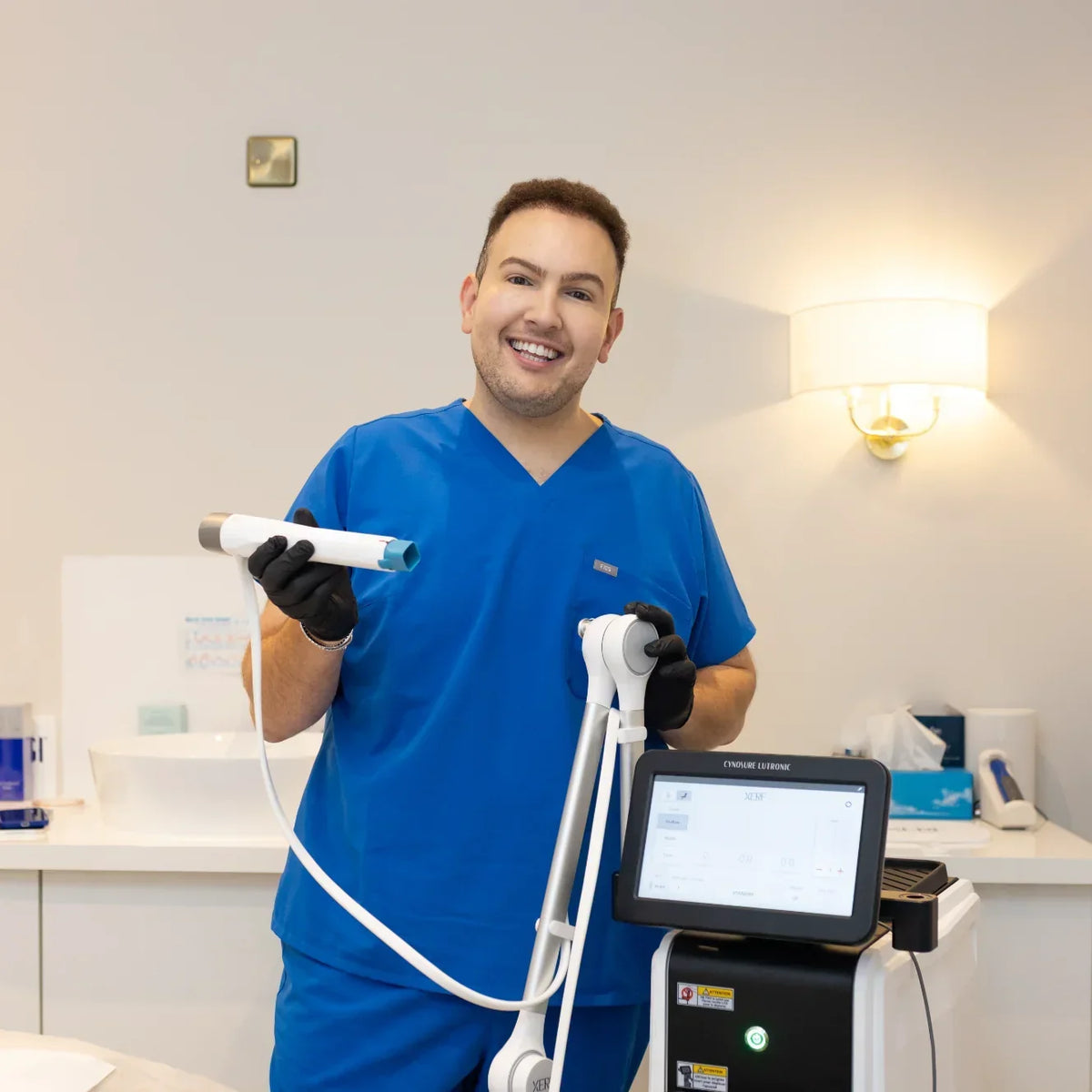
What Is XERF? A Guide to Radiofrequency Skin Tightening
Skin tightening technology has changed considerably in recent years. Rather than simply treating the surface of the skin, newer devices can deliver energy at different depths, targeting some of the structural changes that contribute to increasing laxity.
The XERF machine is part of this newer generation of treatment. It uses multi-frequency monopolar radiofrequency to heat tissue beneath the skin, stimulating a response that can improve firmness and support collagen remodelling over time.
What makes XERF particularly interesting is the control it offers over where radiofrequency energy is delivered. Instead of relying on a single frequency and treatment depth, the technology combines two frequencies with different depth settings, allowing treatment to be adjusted according to the area and condition of the skin.
At The Aesthetics Doctor, where we see patients across London, Cheshire and Leeds, this distinction is important. Loose skin is not one uniform problem. Its severity, location and the other changes occurring alongside it all influence which treatment is likely to be most appropriate.
So, what exactly does the XERF machine do, and where can it fit within a non-surgical approach to skin tightening?
What Is the XERF Machine?
XERF is a non-invasive radiofrequency skin tightening system designed to deliver controlled heat beneath the surface of the skin.
It uses two radiofrequency frequencies, 6.78 MHz and 2 MHz, to distribute energy at different tissue depths. XERF also provides three depth settings and multiple intensity levels, allowing treatment to be adjusted rather than delivering the same energy pattern to every patient.
The principle behind the treatment is relatively straightforward. Controlled heating of the tissue can stimulate a healing response and encourage collagen remodelling. As this process develops, the skin can gradually feel firmer and appear tighter.
Importantly, XERF is not a laser and does not remove the surface of the skin. It also does not use needles, which distinguishes it from radiofrequency microneedling.

How Does XERF Radiofrequency Work?
Radiofrequency treatments use electrical energy to generate controlled heat within tissue.
With XERF, the combination of 6.78 MHz and 2 MHz monopolar radiofrequency allows energy to be distributed through different tissue depths. Your practitioner can select from three depth modes according to the treatment area and what they are trying to achieve.
This matters because the changes we associate with facial ageing do not all occur at exactly the same depth. Someone may have relatively good surface skin but begin to notice softness around the jawline. Another patient may have more widespread loss of firmness across the lower face and neck. Treating these patients identically would overlook important differences in their skin and facial structure.
XERF also incorporates real-time impedance feedback, which assesses how the tissue is responding as energy is delivered. Integrated cooling helps manage the temperature at the skin's surface while energy is delivered beneath it.
The aim is controlled heating, rather than simply making the treatment as hot as possible. More energy is not automatically better. Effective radiofrequency treatment depends on delivering appropriate energy to the right tissue while maintaining patient comfort and safety.

What Does the XERF Machine Do to Collagen?
Collagen provides much of the structural support within the skin, but its production and organisation change as we age. Alongside changes in elastin, fat distribution and deeper facial structures, this can contribute to the skin becoming less firm.
Radiofrequency introduces controlled thermal energy into the tissue. This heating can encourage collagen contraction and stimulate processes involved in new collagen formation and remodelling.
This is why XERF results develop progressively. Unlike dermal filler, where adding physical volume can produce an immediate change in contour, collagen-stimulating energy treatments rely on a biological response that continues after the appointment.
The aim is therefore a gradual improvement in firmness and skin quality rather than a dramatically different appearance immediately after treatment.

What Skin Concerns Can XERF Help With and Who Is It For?
XERF is primarily designed for skin tightening and improving firmness. It may be particularly suitable for people beginning to notice:
-
mild to moderate skin laxity
-
reduced firmness and resilience
-
early facial sagging
-
softening of facial contours
-
loss of definition around the lower face and jawline
It can be a useful option for patients who want gradual improvement in skin firmness without needles or significant recovery, particularly when volume replacement is not the main concern.
However, not every change in facial contour is caused by loose skin. Volume loss, underlying anatomy and more advanced tissue descent can create a similar appearance. Where there is significant excess skin or more advanced laxity, XERF may improve skin quality and firmness without providing the degree of lifting or repositioning someone expects.
At The Aesthetics Doctor, we therefore assess what is causing the visible change and how advanced it is before recommending treatment. XERF is most appropriate when skin laxity and reduced firmness are genuinely the concerns that need addressing.
Can XERF Be Combined With Other Skin Treatments?
Potentially, yes. Combination treatment can be useful when more than one concern is contributing to the way the skin looks. Tightening the skin, for example, does not necessarily address dehydration, pigmentation or surface texture.
Depending on the skin and the concerns being treated, XERF may be combined with:
-
Skin boosters: where improving hydration and overall skin quality is also a priority.
-
Polynucleotides: where improving skin quality, elasticity and resilience is also part of the treatment plan.
-
Alma Harmony laser: where concerns such as skin texture or visible surface changes also need to be addressed.
-
EMFACE: where muscle support is contributing to facial ageing alongside skin laxity.
This does not mean treatments should simply be stacked together. Timing, suitability, treatment area and the patient's individual skin all matter. Sometimes the best approach is to start with one treatment, allow the response to develop and then reassess whether anything else is required.
How Do You Know Whether XERF Is the Right Treatment?
XERF may be a good option if your main concern is mild to moderate skin laxity, reduced firmness or softening of facial contours, and you want to improve these changes without needles or surgery.
It may be particularly relevant if you are beginning to notice:
-
less definition around the jawline
-
mild sagging through the lower face
-
skin that feels less firm or resilient
-
gradual loss of firmness as the skin ages
However, not every change that looks like sagging is caused by loose skin. Loss of facial volume, changes in muscle support and more advanced tissue descent can all affect facial contours. In these cases, XERF alone may not address the underlying cause.
At The Aesthetics Doctor, we therefore assess where the laxity is occurring, its severity and what else is contributing to the change before recommending treatment. For milder laxity, XERF may be used on its own. Where several aspects of facial ageing are occurring together, it may form part of a staged treatment plan.
Ultimately, XERF is most appropriate when skin laxity and loss of firmness are genuinely the concerns that need treating, rather than simply because a patient wants a more lifted appearance.
XERF Machine FAQs
Does XERF use needles?
No. XERF delivers monopolar radiofrequency energy non-invasively, so needles do not enter the skin during treatment.
Is XERF a laser treatment?
No. XERF uses radiofrequency energy rather than laser light. Both technologies can be used within aesthetic medicine, but they generate and deliver energy differently.
Does XERF require numbing cream?
XERF has been designed as a "Never-Numb" treatment and incorporates cooling technology to help manage comfort during energy delivery. Your practitioner will discuss what you can expect before treatment.
Can XERF be used preventatively?
It may be considered where early loss of firmness is beginning to appear, but preventative treatment should still have a clear clinical rationale. Age alone does not determine whether someone needs skin tightening.
Will XERF change the shape of my face?
XERF is designed to improve tissue firmness through radiofrequency heating and collagen remodelling rather than adding volume. The degree of visible change will depend on your starting anatomy and how much skin laxity is contributing to your concern.
Is XERF suitable if I have had other aesthetic treatments?
Previous aesthetic treatments do not automatically rule out XERF, but your full treatment history is important. Your practitioner needs to know what you have had, where it was performed and when before recommending the most appropriate treatment sequence.
Where Can I Have XERF Skin Tightening?
If you are considering the XERF machine for skin tightening, the first step is a consultation to establish whether loss of skin firmness is the main issue and whether radiofrequency is the right approach.
At The Aesthetics Doctor, treatment plans are based on your skin, facial anatomy and the changes you would realistically like to improve. Consultations are available at our clinics in Mayfair, London, Alderley Edge in Cheshire and Leeds, welcoming patients from the surrounding areas and further afield.
Book a consultation with The Aesthetics Doctor to discuss XERF and the most appropriate approach for your skin.
We'd love to hear from you
If you have any questions, please fill in this contact form, and our team will get back to you as soon as possible.
Phone: 020 7305 7777