








Laser vs Microneedling: Which Stimulates More Collagen?
Collagen has become one of the most talked-about topics in aesthetic medicine, but patients are often surprised to learn there isn't a single "best" collagen treatment. The right approach depends on what you're trying to improve, how your skin behaves, and how much structural change is actually needed.
One of the most common questions we hear is whether laser treatments or microneedling stimulate more collagen. Increasingly, patients are also asking where newer technologies such as Matrix fit into the picture.
The short answer is that all three encourage collagen production, but they do so in different ways, at different depths, and for different reasons. Choosing between them is rarely about deciding which is stronger. It is about understanding which form of collagen stimulation your skin is most likely to benefit from.
How does collagen actually change as we get older?
Collagen provides much of the skin's strength, firmness and elasticity. In younger skin, collagen fibres are organised and abundant, allowing the skin to recover quickly from movement and environmental damage.
Over time, collagen production gradually slows while existing collagen becomes fragmented. The result is often a combination of:
-
Fine lines
-
Thinner skin
-
Reduced firmness
-
Enlarged pores
-
Rougher texture
-
Slower healing
-
Acne scars becoming more noticeable
This is why modern skin rejuvenation focuses less on simply treating the surface and more on encouraging the skin to rebuild itself from within.
Do laser treatments and microneedling work in the same way?
Although both treatments trigger the body's natural repair response, they stimulate collagen through different mechanisms.
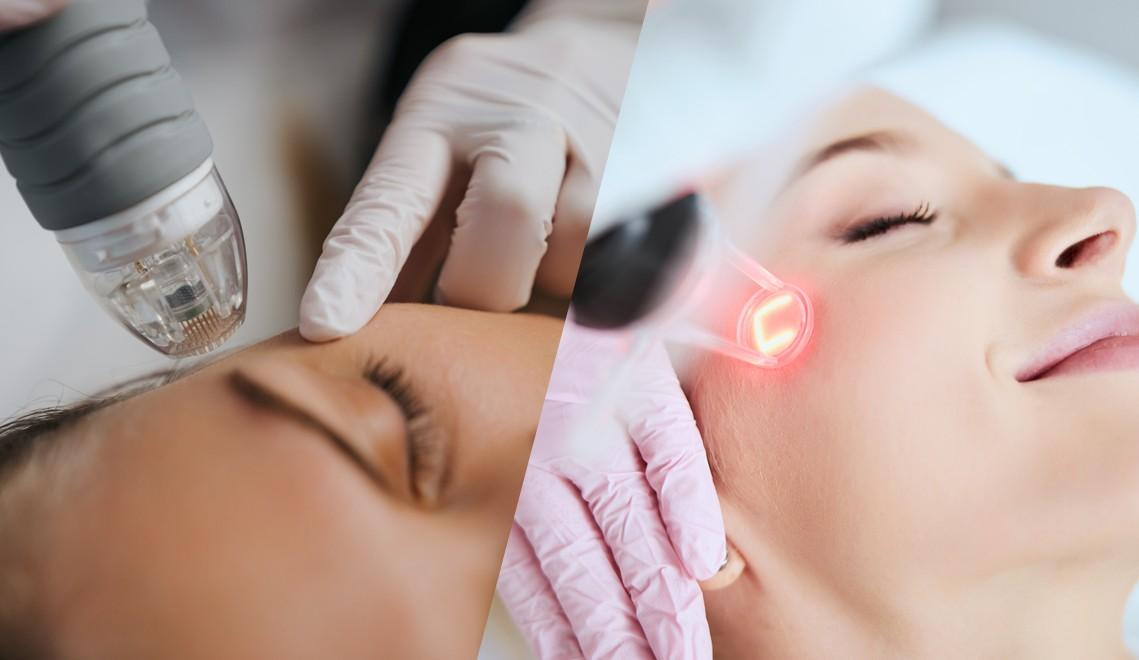
Laser treatments use controlled light energy to create carefully controlled thermal change within the skin. At The Aesthetics Doctor, treatments such as Alma Harmony® can be tailored to address concerns including pigmentation, sun damage, uneven texture and the visible signs of ageing. As the skin responds to this controlled energy, it also stimulates collagen remodelling beneath the surface, helping to improve skin quality, firmness and overall texture over time.
Microneedling works mechanically rather than thermally. Very fine sterile needles create thousands of microscopic channels in the skin, encouraging the body to repair these tiny injuries by producing fresh collagen and elastin.
Both are effective collagen stimulators, but they are solving slightly different problems.
Which treatment produces more collagen?
For general skin rejuvenation, early signs of ageing and improving overall skin quality, microneedling can stimulate significant collagen production with relatively little downtime.
If your concerns include more advanced photoageing, deeper wrinkles or pronounced textural changes, laser resurfacing can often produce more extensive collagen remodelling because controlled thermal energy reaches deeper layers of the skin.
In practice, the decision is rarely about choosing the treatment that produces the most collagen. It is about selecting the type of collagen stimulation that best matches your skin's condition and the changes you want to achieve. Taking this personalised approach is far more likely to deliver the best long-term results.

Where does Matrix fit into the picture?
Rather than choosing between laser or microneedling alone, newer technologies such as Matrix combine different forms of collagen stimulation within a single platform.
Matrix uses a combination of:
-
Radiofrequency microneedling
-
Sub-ablative skin resurfacing
-
Non-invasive wrinkle treatment
Instead of relying on one mechanism of collagen stimulation, Matrix allows practitioners to treat multiple layers of the skin during the same treatment programme. This means skin texture, laxity, fine lines and overall skin quality can often be addressed together while tailoring the treatment to the individual's skin concerns.
In practice, this makes Matrix particularly useful for patients whose skin is showing several different signs of ageing rather than one isolated concern.
Is microneedling enough for younger skin?
For patients beginning to notice:
-
Mild loss of firmness
-
Enlarged pores
-
Early fine lines
-
Acne scarring
-
Dull skin
-
Uneven texture
we would usually start with microneedling before considering more intensive resurfacing.
Because the treatment relies on the body's own healing response, improvements develop gradually over several weeks as collagen continues forming beneath the skin. Most patients achieve the best results through a course of treatments rather than a single session.
When is laser treatment the better choice?
Laser treatment tends to become more valuable when collagen loss is only part of the picture.
For example, patients may also have:
-
Sun damage
-
Pigmentation
-
Deeper lines
-
More established photoageing
-
Irregular skin texture
In these situations, laser treatments can improve visible surface damage while also encouraging collagen remodelling underneath. This makes them particularly useful when multiple age-related skin changes are present simultaneously.
Can Matrix replace both laser and microneedling?
Matrix offers another option for patients who require collagen stimulation across several skin layers at once.
At The Aesthetics Doctor, we often see patients who initially believe they need one specific treatment after reading about it online. Following assessment, it may become clear that another approach is likely to produce better long-term improvement because the skin is ageing in more than one way.
For some patients, Matrix may provide the most comprehensive option. For others, traditional microneedling or laser treatment remains the better choice. The decision is based on the skin rather than the popularity of the technology.
Can collagen treatments be combined?
Different treatments influence the skin in different ways, which means carefully combining them can often produce more balanced improvements than relying on a single procedure.
For milder cases, treatment may begin with microneedling before introducing additional therapies if further correction is needed.
In more advanced cases, Matrix may form the foundation of treatment because it addresses multiple levels of the skin simultaneously. Depending on the individual's concerns, this can then be supported with treatments such as Chemical Peels to improve superficial skin renewal or Harmony BioBoost to optimise overall skin quality and hydration as part of a broader treatment plan.
The aim is never simply to perform more procedures. It is to select treatments that complement one another without unnecessarily increasing downtime.
How many collagen treatments will I need?
One treatment can certainly improve the skin, but collagen remodelling is a gradual biological process rather than an instant cosmetic change. Most patients notice progressive improvement over several months as new collagen matures.
The exact number of sessions depends on several factors, including:
-
Your age
-
Existing collagen loss
-
Skin thickness
-
Degree of sun damage
-
Acne scarring
-
Lifestyle factors such as smoking and UV exposure
Patients with early signs of ageing usually require fewer sessions than someone seeking significant improvement in longstanding acne scars or advanced skin laxity.
So which treatment is best?
There is no universal winner. Microneedling remains one of the most effective treatments for stimulating natural collagen in younger or mildly ageing skin. Laser treatments are often preferred when more significant surface correction is required alongside collagen remodelling.
Matrix offers a more versatile option by combining multiple collagen-stimulating technologies within a single treatment platform, making it particularly useful for patients with several overlapping skin concerns.
Ultimately, the treatment that stimulates the "most" collagen is not necessarily the treatment that delivers the best outcome for your skin. The best results come from choosing the right technology at the right stage of skin ageing.
Frequently Asked Questions
Does collagen continue to improve after treatment?
Yes. New collagen develops gradually, so improvements often continue for several months after your final treatment session.
Can collagen stimulation prevent ageing?
No treatment can stop the ageing process, but stimulating collagen can help slow visible changes and maintain healthier skin for longer.
Is Matrix suitable for all skin types?
Suitability depends on your skin type, concerns and medical history. During consultation, your practitioner will determine whether Matrix or another treatment is the safest and most appropriate option.
Can I have microneedling if I've previously had laser treatment?
Often, yes. Many patients have both treatments at different stages of their skin journey. The timing depends on skin recovery and your overall treatment plan.
Does collagen stimulation look natural?
Yes. Because these treatments encourage your own skin to regenerate rather than adding volume, results generally develop gradually and maintain natural facial movement and expression.
Considering collagen-stimulating treatments?
If you're unsure whether laser, microneedling or Matrix is the most appropriate option, a consultation allows us to assess how your skin is ageing rather than recommending a one-size-fits-all treatment. At The Aesthetics Doctor, every treatment plan is tailored to your individual skin, concerns and long-term goals.
Whether you're looking to improve skin texture, address signs of ageing or simply understand which collagen-stimulating treatment is right for you, we're here to help. Contact us to arrange a consultation at one of our clinics in Leeds, London or Cheshire, where our experienced team can assess your skin and recommend the most appropriate, evidence-based treatment plan for you.
We'd love to hear from you
If you have any questions, please fill in this contact form, and our team will get back to you as soon as possible.
Phone: 020 7305 7777